decareto has carried out an automated analysis of 82 websites belonging to the State-level party organizations of the political parties represented in the 16 German state parliaments.
Two key compliance issues for websites
How well do the websites of German political parties’ state branches perform in terms of data protection and digital accessibility?
The analysis focused on two key aspects of digital compliance: potential data protection gaps and technical barriers to digital accessibility. The aim of the analysis was to provide a cross-party overview and to highlight the extent to which there is room for improvement. The analysis assessed the distribution of risk scores across the websites of the individual state associations. In addition, an overall score was calculated for each party.
The results differ significantly: In terms of data protection, the websites examined perform better overall than they do in terms of digital accessibility. Whilst 78 per cent of the websites (64 out of 82) show signs of data protection gaps, 99 per cent of the websites (81 out of 82) display automatically detectable anomalies in terms of accessibility.
At the same time, the analysis makes it clear that both issues require ongoing attention. A cookie banner and a privacy policy do not automatically make a website compliant with data protection regulations. The crucial factor is whether the technical data processing, the consent mechanisms and the information in the privacy policy actually align.
The analysis of digital accessibility examines whether technical and structural barriers could make it difficult to perceive, use or understand a website. This includes, amongst other things, the accessibility of content, a clear page structure, and the usability of navigation, links, buttons and forms.
Political websites bear a special digital responsibility
Political parties aim to inform people, communicate political positions and facilitate civic participation.
Political websites are therefore a key point of contact for citizens. The responsible handling of personal data is of particular importance when citizens use contact forms, subscribe to newsletters or enquire about membership and opportunities for participation. A transparent and data-protection-conscious technical design helps to build trust in these services.
Accessibility is particularly relevant from the perspective of participation: Citizens should be able to access political information and opportunities for participation as independently as possible, regardless of whether they rely on, for example, keyboard navigation, screen readers, zoom functions or other assistive technologies. If these conditions are not met, a significant number of users will be excluded from these digital services. In view of demographic trends in Germany, the participation of older people in digital services deserves special emphasis.
Accessibility shows the greatest potential for improvement
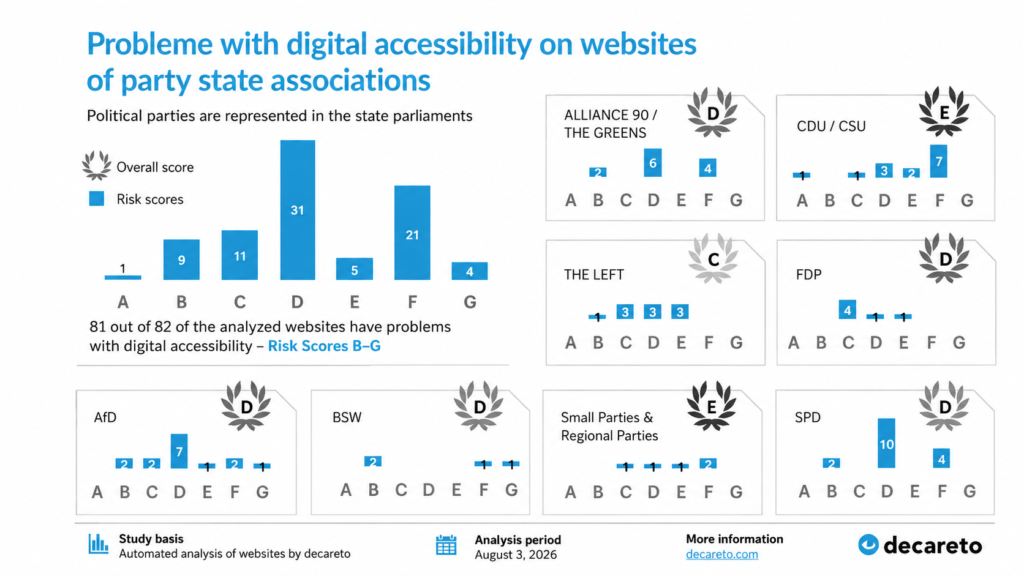
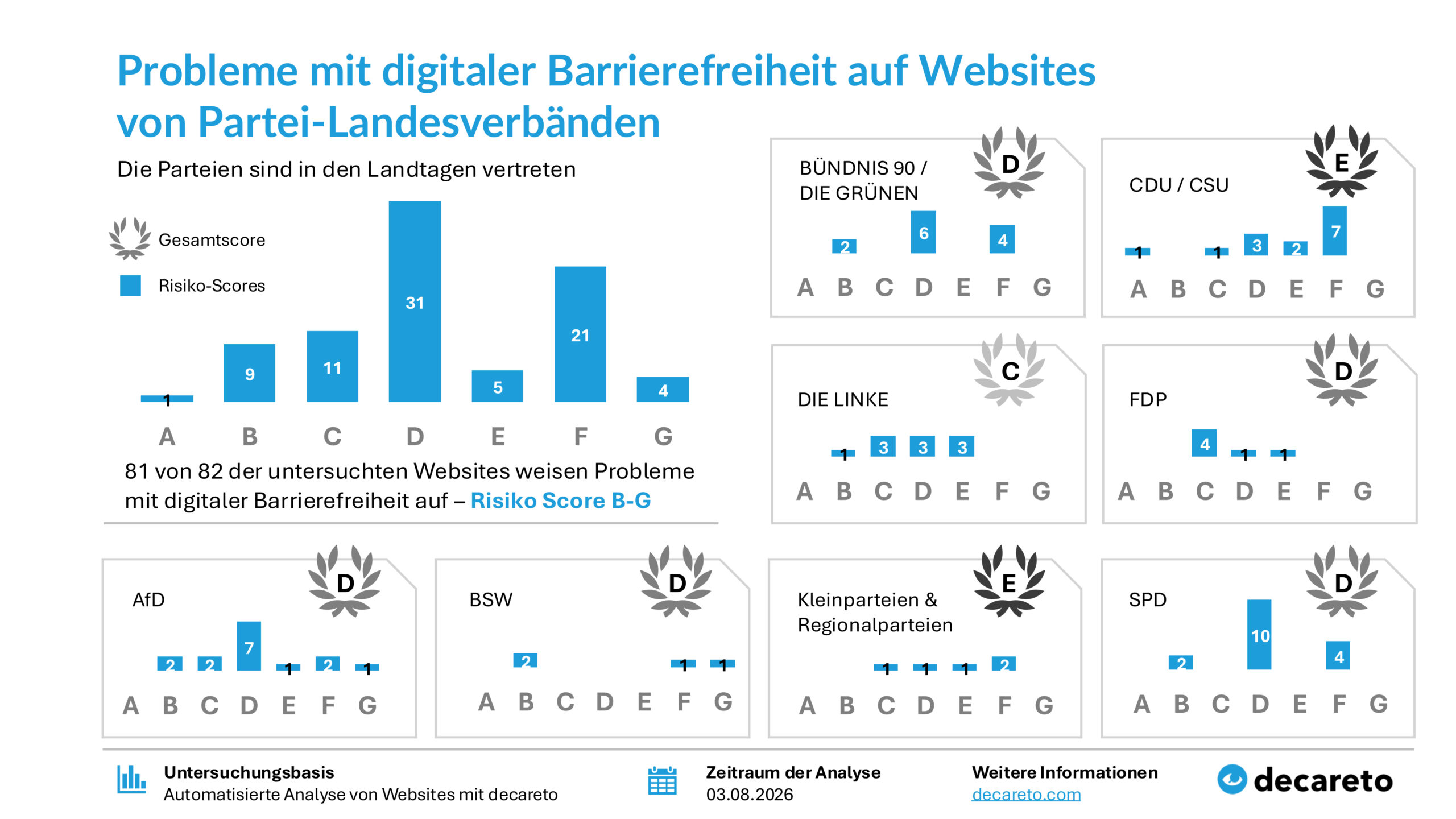
The assessment was carried out on a scale from A (best) to G (worst). The results for digital accessibility are striking. Only one of the 82 websites examined achieved a risk score of A – that is 1 per cent. There are indications of accessibility issues on 99 per cent of the websites examined.
The websites were classified as follows:
- 1 website (1 per cent) with a score of A
- 9 websites (11 per cent) with a score of B
- 11 websites (13 per cent) with a score of C
- 31 websites (38 per cent) with a score of D
- 5 websites (6 per cent) with a score of E
- 21 websites (26 per cent) with a score of F
- 4 websites (5 per cent) with a score of G
The average overall score per party was also examined. Here, too, the picture is mixed. The party ‘Die Linke’ performed best, with an overall score of C. On average, the SPD achieved an overall score of D. This puts it on a par with the AfD, BSW, Alliance 90/The Greens and the FDP. The CDU/CSU, as well as the smaller and regional parties, each achieved an overall score of E.During the scan for accessibility issues, automatically detectable issues were identified. These may relate, for example, to contrast, alternative text for images, form labels, links and buttons, language settings or heading structures. The issues identified provide an overview of a website’s technical accessibility problems and highlight areas where action is required.
Important to note: Automated checks can only detect some of the potential accessibility issues and are no substitute for a comprehensive manual audit. However, they do provide specific technical indications of where further investigation is warranted.
The data protection scan reveals a more nuanced picture
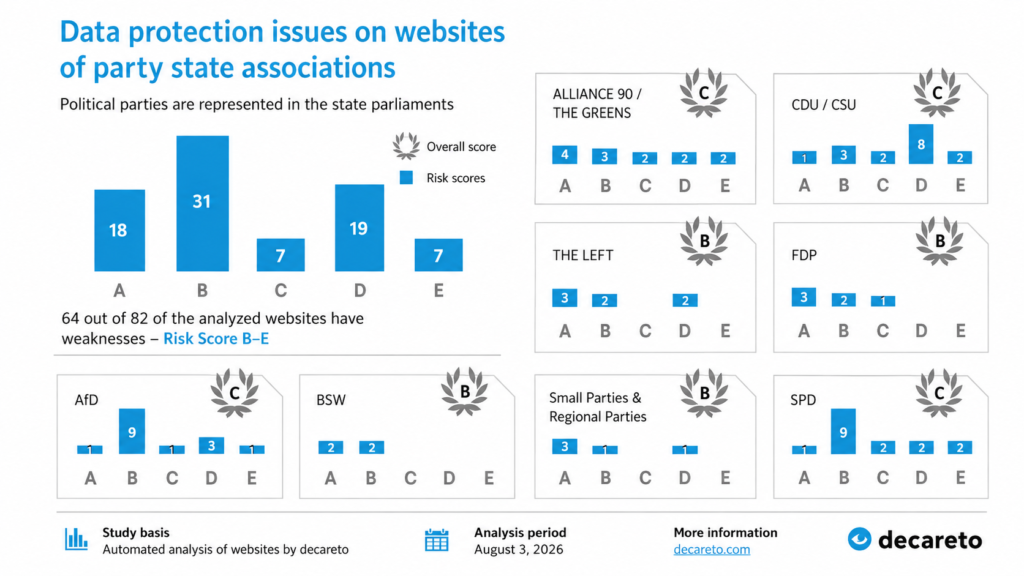
When it comes to data protection, the results are more mixed. This issue appears to be more firmly embedded in the implementation of the websites. 22 per cent (18 out of 82) of the websites achieved an ‘A’ score – the highest rating in the analysis. At the same time, in a total of 78 per cent (64 out of 82) of the websites, technical anomalies or risk indicators were identified.
The result:
- 22 per cent (18) of the websites with a score of A
- 38 per cent (31) of the websites with a score of B
- 9 per cent (7) of the websites with a score of C
- 23 per cent (19) of the websites with a score of D
- 9 per cent (7) of the websites with a score of E
The average overall score per party was also calculated based on the results of the data protection scans. The average scores of the parties are very close: 4 ‘B’ ratings and 4 ‘C’ ratings. With an overall rating of ‘B’, the BSW, Die Linke, the FDP and the smaller and regional parties performed best in the comparison. The AfD, Bündnis 90/Die Grünen, the CDU/CSU and the SPD each achieved an overall rating of ‘C’.
The results thus highlight examples of sound technical implementation on the one hand, whilst also revealing further potential for optimisation on the other.
The results cover the entire political spectrum
The analysis reveals differences between individual party’s regional associations, but at the same time highlights a clear commonality: Potential for improvement in data protection and accessibility cannot be attributed to any particular political orientation.
When it comes to digital accessibility, all party groups consistently have regional associations with medium or higher risk scores. An accessible website is the exception rather than the rule here.
The picture is more nuanced when it comes to data protection: various party regional associations have websites with an A or B score, whilst at the same time some regional associations exhibit higher risk scores. Overall, the issue of data protection compliance is more firmly embedded in the design of the websites.
Nevertheless, for a significant number of the websites examined, there is room for improvement with regard to potential data protection loopholes and automatically detectable barriers.
As became apparent when examining the overall scores by party, the focus is less on the performance of individual parties and more on a common question: How can political websites be designed to be permanently accessible, data protection-conscious and user-friendly?
What political parties and web agencies can do in practice
Many technical issues arise from reused templates, design systems, CMS components, form modules or integrated third-party services. Improvements to these key areas can therefore have an impact on numerous subpages simultaneously.
Possible starting points are:
- Consider accessibility early on: Check navigation, buttons, forms, dialogue boxes and consent banners for accessibility right from the design and development stages.
- Regularly review data protection: Technically review tracking, cookies, external services, consent mechanisms and form processes.
- Establish automated monitoring: Use recurring scans to identify changes and new technical issues at an early stage.
- Supplement with manual accessibility testing: Practically test key user flows using a keyboard, screen readers and magnification functions.
- Align responsibilities: Involve editorial, development, UX, data protection and in joint quality processes.
Conclusion: A shared quality challenge for political websites
Above all, the analysis yields one key finding: Across all the party websites examined, there is significant scope for improvement in digital accessibility. The picture is more nuanced when it comes to data protection; however, here too, many websites reveal technical areas where improvements can be made.
The results are not intended to single out individual parties for criticism. Rather, they show that data protection and digital accessibility are ongoing quality priorities for political websites.
Automated checks can serve as a starting point for this by highlighting technical issues and enabling targeted prioritisation. Combined with manual testing and expert assessment, they can support political parties and web agencies in continuously improving their websites.
The aim is as simple as it is relevant: Political information should be accessible to as many people as possible and made available via digital platforms that citizens can trust.
About the analysis
The study examined 82 websites of state branches of the parties represented in German state parliaments. The automated analysis was carried out using the decareto platform for website compliance analysis on 3 August 2026.
The scores and findings identified represent technical risk indicators and are expressly not to be equated with a conclusive legal assessment or a comprehensive accessibility audit.
The following websites of German party state associations were examined
AfD Landesverband Hamburg, AfD Landesverband Niedersachsen, AfD Landesverband NRW, AfD Landesverband Rheinland-Pfalz, AfD Landesverband Saarland, AfD Landesverband Sachsen, AfD Landesverband Sachsen-Anhalt, AfD Landesverband Thüringen, AfD Mecklenburg-Vorpommern, BSW Brandenburg, BSW Landesverband Berlin, BSW Landesverband Sachsen, BSW Landesverband Thüringen, BÜNDNIS 90/DIE GRÜNEN Berlin, BÜNDNIS 90/DIE GRÜNEN Rheinland-Pfalz, BÜNDNIS 90/DIE GRÜNEN Baden-Württemberg, BÜNDNIS 90/DIE GRÜNEN Hessen, BÜNDNIS 90/DIE GRÜNEN Landesverband Bayern, BÜNDNIS 90/DIE GRÜNEN Landesverband Niedersachsen, BÜNDNIS 90/DIE GRÜNEN Landesverband NRW, BÜNDNIS 90/DIE GRÜNEN Landesverband Schleswig-Holstein, BÜNDNIS 90/DIE GRÜNEN Mecklenburg-Vorpommern, BÜNDNIS 90/DIE GRÜNEN Sachsen, BÜNDNIS 90/DIE GRÜNEN Sachsen-Anhalt, BÜNDNIS 90/DIE GRÜNEN Landesverband Bremen, BÜNDNIS DEUTSCHLAND Landesverband Bremen, Bürgerallianz Bremen/Bremerhaven, CDU Hessen, CDU in Niedersachsen, CDU Landesverband Berlin, CDU Landesverband Bremen, CDU Landesverband Hamburg, CDU Landesverband Mecklenburg-Vorpommern, CDU Landesverband Nordrhein-Westfalen, CDU Landesverband Rheinland-Pfalz, CDU Landesverband Saar, CDU Landesverband Thüringen, CDU Sachsen, CDU Sachsen-Anhalt, CDU Schleswig-Holstein, CDU-Landesverband Baden-Württemberg, CDU-Landesverband Brandenburg, CSU-Bayern, Die Linke Berlin, Die Linke Hamburg, Die Linke Landesverband Bremen, Die Linke Landesverband Sachsen-Anhalt, Die Linke Mecklenburg-Vorpommern, Die Linke Sachsen, Die Linke Thüringen, FDP Fraktion Schleswig-Holstein, FDP Landesverband Bremen, FDP Landesverband Hessen e.V., FDP Landesverband Mecklenburg-Vorpommern, FDP Landesverband NRW, FDP Sachsen-Anhalt, Freie Wähler in Bayern, Freie Wähler Sachsen e.V., GRÜNER Landesverband Hamburg, SPD Landesverband Berlin, SPD – BayernSPD Landesverband, SPD Brandenburg, SPD Landesorganisation Hamburg, SPD Landesverband Hessen, SPD Landesverband Nordrhein-Westfalen, SPD Landesverband Saarland, SPD Landesverband Sachsen, SPD Mecklenburg-Vorpommern, SPD Rheinland-Pfalz, SPD Sachsen-Anhalt, SPD Schleswig-Holstein, SPD-Landesorganisation Bremen, SPD-Landesverband Baden-Württemberg, SPD-Landesverband Niedersachsen, SPD-Landesverband Thüringen, Südschleswigscher Wählerverband